
News
USA Delivers Significant Indirect Cost Savings Results with New GOSP
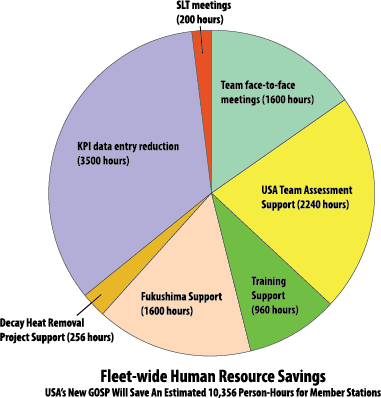
The Utilities Service Alliance (USA) estimates that changes to its governance model approved by the Board of Directors at its Nov. 1 meeting will provide member stations with more than 10,000 person-hours of indirect cost savings.
USA estimates include the hours saved by eliminating face-to-face meetings, reducing USA assessment support and reducing Key Performance Indicator (KPI) requirements.
“In October, USA announced changes to its Governance, Oversight, Support and Perform (GOSP) model to concentrate fleet focus on specific performance gap areas, reduce administrative burden, and provide an overall net reduction in indirect costs to member stations,” said John Christensen, USA Vice President of Operational Performance. “These indirect cost savings not only reduce member station burden, but also allow USA to meet its strategic objectives to improve plant safety and performance, provide economic benefit, and provide industry leadership.”
USA estimates the new GOSP reduces fleet-wide resource requirements by 10,356 person-hours, including:
• Team face-to-face meetings (1,600 hours)
• USA Team Assessment support (2,240 hours)
• Training support (960 hours)
• Fukushima support (1,600 hours)
• Decay Heat Removal Project support (256 hours)
• KPI data entry reduction (3,500 hours)
• Site Leadership Team (SLT) meetings (200 hours)
The reductions bring with them additional savings in the form of approximately:
• 127 airline tickets
• 536 hotel stays
• 127 car rentals.
 The KPI data entry savings are the result of reducing the USA KPI suite from 175 measures to 16 metrics needed to monitor USA’s Gap Focus Areas of Reactivity Management, Scope and Schedule Stability, Human Performance and Industrial Safety, as well as its focus on Sustaining Training Excellence.
A team comprised of Andy Brown, USA Manager of Performance Analysis, Doug Davis and Jim Gallman of Comanche Peak, and Tim Donovan, USA Director of Fleet Improvement and Support, identified and eliminated all KPIs in the USA suite that duplicate any information provided in support of current industry or regulatory KPIs.
The needs of USA Gap Focus owners were the primary drivers for continued use of these KPIs. The remaining KPIs include:
• Human Performance Event Rate
• Industrial Safety Injury Rate
• BWR Reactivity Management
• PWR Reactivity Management
• Critical Scope Survival (Average of last 3 months)
• FIN Team Effectiveness
• On Line CC Backlog
• On Line CN Backlog
• On Line DC Backlog
• On Line DN Backlog
• Ready to Work (Walkdowns/Task Ready)
• Weekly Schedule Adherence
• Critical PM in 2nd Half of Grace (PIC)
• On-Line Schedule Stability
• On-Line Scope Stability
• Total PM in 2nd Half of Grace (PIC).
Since USA is built on sharing resources and expertise, certain resource requirements remain. USA estimates the Gap Focus Area Resource Commitment for each station at 282 person-hours annually for host peers and peers, approximately three airline tickets, 12 hotel stays and three car rentals. USA estimates the Training Sustainability Resource Commitment at 448 hours for peers (based on eight review visits and eight mock boards), approximately 16 airline tickets, 56 hotel stays and 16 car rentals.
Even with these commitments, the fleet will realize a combined annual net reduction of 8,498 person-hours, 96 airline tickets, 420 hotel stays and 96 car rentals.
USA is an alliance consisting of six Full-member utilities operating seven nuclear power stations including Columbia, Comanche Peak, Fermi, Monticello, Prairie Island, Susquehanna and South Texas, and two Efficiency-member utilities operating Cooper Nuclear Station and Cook station. Combined, our Full-member stations generate more than 12,000 megawatts of energy. In addition to administering a network of more than 60 nuclear suppliers, USA helps its members leverage their combined resources, talent and expertise to serve their customers with clean, safe, reliable and cost-efficient energy. It is on the web at www.usainc.org.