
News
Personnel sharing has many benefits for USA/STARS members
According to the U.S. Department of Labor, Labor Day is “a yearly national tribute to the contributions workers have made to the strength, prosperity, and well-being of our country.” It’s also a great time to recognize the contributions of the Utilities Service Alliance (USA)/STARS Personnel Sharing Program – which enables members to borrow and share skilled craft workers and supervisors with other member stations.
Mark Persky of Diablo Canyon Nuclear Power Plant, the Team Leader for the USA/STARS Personnel Sharing Program, reported that in 2015, the last year for which complete data is available, member stations that loaned employees saved more than $1.84 million with the program while avoiding costs that might be accrued during significant down time.
With 122 employees either scheduled or already loaned/borrowed so far in 2016, the personnel sharing program exemplifies how the alliance strengthens its members by driving better performance and helping them save money.
“Stations who receive employees can quickly fill manpower and expertise needs for outages and emergent situations,” says USA’s Tim Donovan, Director of Programs and Projects. “Stations on the receiving end also can learn from the expertise of these experienced nuclear employees.”
But there are benefits for the stations who loan employees and the employees themselves, as well, Donovan adds.
“Loaned employees gain insight into how processes compare to those carried out at their home station,” he says. “With the need to continuously improve outage performance, sharing personnel between plants saves time and money, and will continue to be an important aspect of the path to excellence.”
By sharing employees who are already accustomed to the rigors of work in commercial nuclear power – nuclear safety, operating experience, ongoing training and daily work experiences – USA member utilities get workers who are very close to “turn-key” when they arrive on a site, Donovan says.
“The employees walk in knowing the industry standards they must adhere to and much of the in-processing rigor is reduced or eliminated, creating just one of several financial benefits.”
The cost to the stations is the actual cost of the employee, which is reimbursed via invoicing from the loaning station to the receiving station. As a guideline, the stations report that each loaned USA employee eliminates the need for up to two supplemental workers.
Donovan says the financial benefits to loaning stations are two-fold. First, the loaning station saves the total amount of the invoiced cost for the loaned employees. Second, the loaning station improves its efficiency.
“During the operating cycle of any plant, there are times of low productivity in virtually every department,” he explains. “When a station plans carefully to loan employees during these times, the number of low-productivity work hours is reduced.”
In 2015, the average bill rate for a USA member utility was $42 per hour over 4,382 loaned days. Assuming 10 hours per day worked means loaning stations saved more than $1.84 million in O&M costs.
“In many instances, those were hours of low productivity had the employee not been loaned,” Donovan says.
USA’s Personnel Sharing Program is just one of several ways USA has improved performance and efficiency for members. Others include volume discounts and rebates on equipment and components, shared expertise for emergent issues and monitoring of major functional areas across the USA fleet.
USA is an alliance of seven utilities operating eight nuclear power stations generating 13,192 megawatts of energy. In addition to administering a network of more than 70 nuclear suppliers, USA helps its members leverage their combined resources, talent and expertise to serve their customers with clean, safe, reliable and cost-efficient energy.
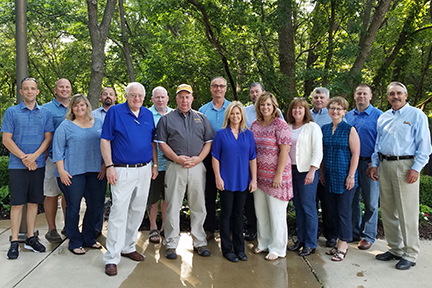
The USA/STARS Personnel Sharing Team met at USA Headquarters in June to plan the Personnel Sharing Schedule for 2017.